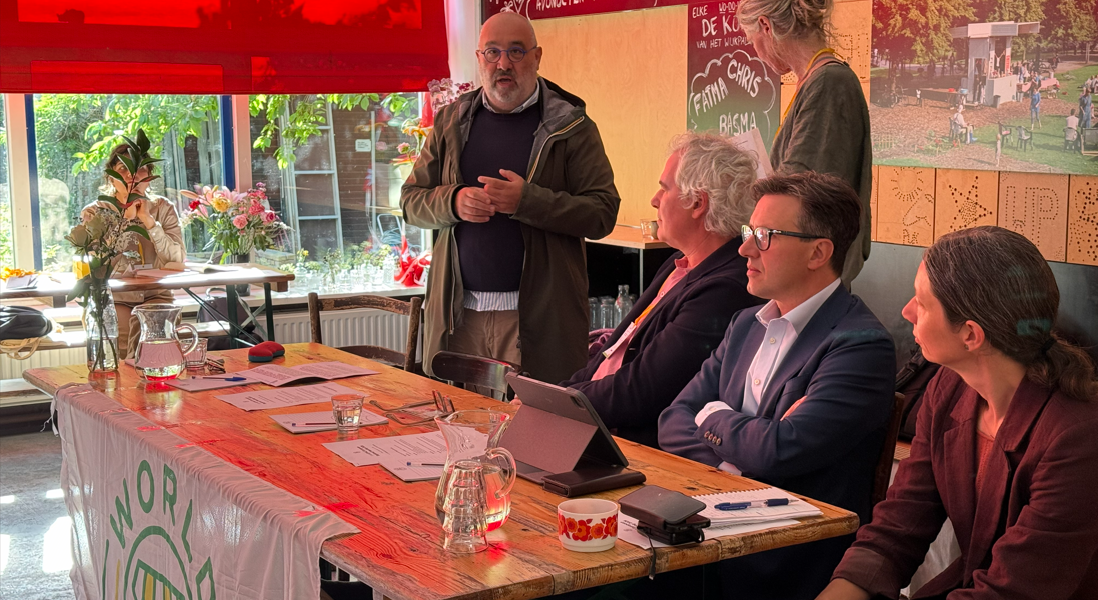
At the 2nd WorldFMC European Regional Meeting, held at a crucial moment for both global geopolitics and the future of European agricultural policy, Carmelo Troccli, the Coalition’s Director General highlighted the urgent challenges facing farmers markets across Europe while reaffirming their strategic role as tools for innovation, resilience, and social transformation.
As debates continue around the future of the European Union’s Common Agricultural Policy (CAP), the meeting offered an important opportunity to reflect on the future of small-scale farming, generational renewal, food sovereignty, and the strengthening of local food systems.
The Crisis Facing Small Farms in Europe
Although the average agricultural income in Europe has increased in recent years, this figure masks profound inequalities between regions and farming models. Small family farms, which still represent the vast majority of European farms, remain particularly vulnerable to price volatility, rising production costs, and increasingly complex market dynamics.
These vulnerabilities have become even more visible in recent years as conflicts, economic instability, and global pandemics have exposed the fragility of agri-food systems and disproportionately affected both farmers and consumers, especially the most vulnerable communities.
Between 2010 and 2020, Europe lost around 3 million farms, declining from approximately 12 million to 9 million holdings. This dramatic reduction mainly affected owner-operated farms and reflects a longer-term structural trend toward the concentration of agricultural production and the disappearance of smallholders.
At the same time, Europe is facing a critical challenge in generational renewal. Only 12% of farm managers are under the age of 40, and just 5.6% are under 35. Younger farmers often operate under more difficult economic conditions, making agriculture an increasingly inaccessible sector for new generations and threatening the continuity of local knowledge, traditions, and rural communities.
Food Systems Under Pressure
The challenges are not limited to the agricultural sector alone. Across Europe, access to healthy, nutritious, and locally sourced food is becoming increasingly difficult for many citizens.
The growing consumption of heavily marketed ultra-processed foods has contributed to rising levels of diet-related diseases, particularly among younger generations. Meanwhile, food insecurity remains widespread, especially in remote and rural areas, while food waste continues to grow alongside increasing demand for food assistance in urban centres.
These contradictions reveal the urgent need for a different food system, one that reconnects production, consumption, health, and community.
Multifunctional Agriculture: A Model for the Future
In response to these challenges, the WorldFMC reaffirmed the importance of multifunctional agriculture as a key strategy for building more resilient local food systems.
Multifunctional agriculture combines farming with activities such as direct sales, short supply chains, food education, hospitality, social engagement, and community services. By diversifying income sources and reducing dependence on wholesale markets alone, farms become more adaptable and economically resilient.
Italy offers a significant example of this transition. Since the early 2000s, multifunctional agriculture has contributed to:
- greater resilience to climate and economic crises;
- higher levels of innovation among farms;
- stronger youth and women participation in agriculture;
- increased employment opportunities;
- improved farm income and long-term sustainability.
The model is also expanding across Europe, with approximately one quarter of European farms now engaged in related multifunctional activities.
Farmers Markets as Innovation Hubs
Within this framework, farmers markets represent one of the clearest and most tangible expressions of multifunctional agriculture.
They are not simply alternative sales channels, but genuine innovation hubs that strengthen the relationship between producers and consumers, shorten supply chains, and promote local, sustainable, and high-quality food.
Most importantly, farmers markets create new economic and social opportunities for small producers, helping agriculture become more inclusive, resilient, and community-oriented.
The WorldFMC also stressed the importance of participation in European projects as a strategic tool to strengthen farmers markets, support members’ daily activities, encourage knowledge exchange, and disseminate best practices across Europe.
Beyond Markets: Building Local Food Systems
Farmers markets are increasingly recognised not only for their economic value, but also for their broader contribution to environmental sustainability, biodiversity conservation, land protection, and food sovereignty.
They help reshape the relationship between rural and urban areas while contributing to the revitalisation of public spaces and local communities. Through collaboration with schools, hospitals, food redistribution initiatives, and public and private catering systems, farmers markets can become central actors in healthier and more socially cohesive cities.
This approach places citizens’ health, solidarity, and respect for farmers’ work at the centre of food systems, contributing to stronger and more connected communities.
A Call for Institutional Recognition
As discussions continue on the future of the Common Agricultural Policy, the WorldFMC called for farmers markets to be formally recognised by European, national, and local institutions as strategic tools for supporting family farm incomes and strengthening local food systems.
Such recognition, it was argued, should be accompanied by coherent regulatory frameworks capable of supporting associations, local institutions, and communities engaged in the development of short supply chains and sustainable territorial food systems.
The speech also underlined the need for stronger associative forms of organisation capable of jointly representing the interests of farmers and consumers, moving beyond the management of individual markets toward a broader socio-economic vision.
Transparency, respect for legislation, and clear internal rules were identified as essential conditions for farmers’ markets to be recognised as credible and distinct actors within contemporary food systems.