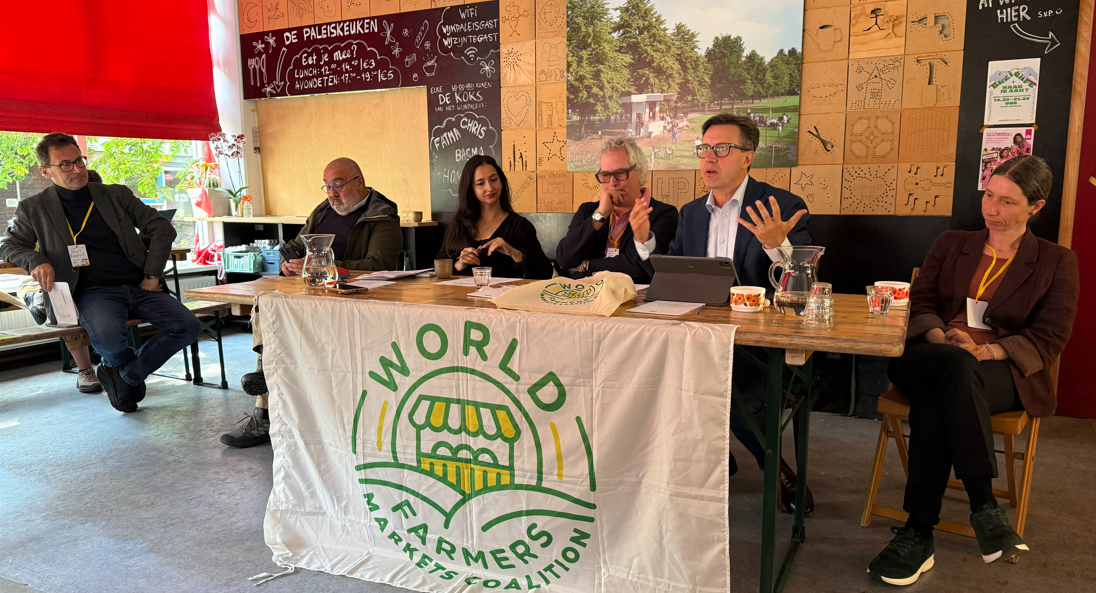
During the 2nd WorldFMC European Regional Meeting, Member of the European Parliament Dario Nardella delivered a strong message on the strategic importance of farmers markets and local food systems for the future of Europe.
Speaking in the context of ongoing debates on the future of the Common Agricultural Policy (CAP), Nardella highlighted how farmers markets are increasingly emerging as essential tools for food resilience, biodiversity protection, territorial cohesion, and rural development.
Local Food at the Centre of Europe’s Future
Opening his remarks, Nardella underlined that the debate around local food and farmers markets remains one of the most important, yet still underestimate, issues in European policymaking.
At a time when Europe is facing geopolitical instability, energy shocks, supply chain disruptions, and growing concerns over food security, he stressed the urgency of strengthening local food systems capable of reducing dependency on fragile global supply chains.
“The question of where our food comes from has never been more urgent,” he stated, recalling how recent crises have exposed the vulnerability of long and complex supply chains.
According to Nardella, local food systems are not simply niche or lifestyle choices, but a concrete response to contemporary challenges. Short supply chains provide greater resilience to external shocks, reduce waste and emissions, improve food quality, and strengthen the relationship between producers and consumers.
Most importantly, he emphasised their social value in keeping rural communities economically and socially alive.
The CAP Must Better Support Local Food Systems
A central focus of the speech was the future reform of the European Union’s Common Agricultural Policy beyond 2027.
Nardella acknowledged that the CAP already contains instruments supporting short supply chains, local markets, producer groups, and rural cooperation through its rural development pillar. However, he warned that these measures are still underused and insufficiently prioritised within national strategic plans.
“Too often, CAP strategic plans continue to favour large-scale, export-oriented models at the expense of local and proximity-based food systems,” he noted.
He called for a stronger political commitment to:
- support short food supply chains and farmers markets;
- promote public procurement policies favouring local food in schools, hospitals, and public canteens;
- reward farmers not only for environmental outcomes, but also for their contribution to resilient and diversified local food systems.
Nardella also stressed the need to rebalance CAP financial support toward smaller farms. He criticised the current concentration of subsidies, pointing out that a significant share of CAP resources still benefits a limited percentage of large agricultural companies.
Farmers Markets as Guardians of Biodiversity and Culture
Throughout the speech, Nardella repeatedly highlighted the broader cultural and environmental value of farmers markets.
He described them as active promoters of biodiversity, local traditions, and cultural heritage, places where citizens and visitors can genuinely connect with local identities, food cultures, and agricultural knowledge.
“If we want to understand local traditions and local food cultures, we cannot go only to supermarkets,” he remarked. “Farmers markets are also cultural heritage.”
In this sense, farmers markets contribute not only to agricultural development, but also to territorial cohesion and community-building across Europe.
Bridging Rural and Urban Communities
Drawing on his experience as former Mayor of Florence and former President of Eurocities, Nardella stressed the importance of strengthening collaboration between cities and farmers’ organisations.
He proposed building a stronger “European pact” between urban areas and farmers markets, recognising cities as strategic actors in supporting local food systems, sustainable food procurement, and rural-urban cooperation.
According to him, this collaboration should extend beyond the European Union itself and involve neighbouring countries and candidate states across the broader European continent and Mediterranean region.
Simplification Without Lowering Standards
Another key issue addressed was the need to simplify administrative procedures for farmers and small agricultural enterprises.
Nardella welcomed ongoing European efforts to reduce bureaucracy through the new agricultural omnibus package, while warning that simplification should not mean weakening food safety, quality, or environmental standards.
“Too often, family farms spend more time on paperwork than on the land itself,” he said.
He particularly stressed the importance of reducing administrative burdens for small family farms and multifunctional agricultural businesses engaged in direct sales and farmers’ markets.
Toward a European Recognition of Farmers Markets
In the concluding part of his intervention, Nardella called for the creation of a specific European framework dedicated to farmers markets and multifunctional agriculture.
He argued that farmers markets cannot be treated like conventional commercial spaces because they combine production, direct sales, cultural promotion, and social functions.
According to Nardella, Europe now needs:
- stronger promotion and protection policies for farmers markets;
- dedicated support measures for small farmers;
- a clearer institutional recognition of multifunctional agriculture;
- and a cultural shift in how society perceives the role of farmers today.
“Through farmers markets, citizens understand how complex and valuable farmers’ work truly is,” he concluded.
Reaffirming his commitment to the sector, Nardella closed his speech by offering his support as an interlocutor within the European Parliament and expressing his willingness to help bring the voice of farmers markets into the heart of European policymaking.