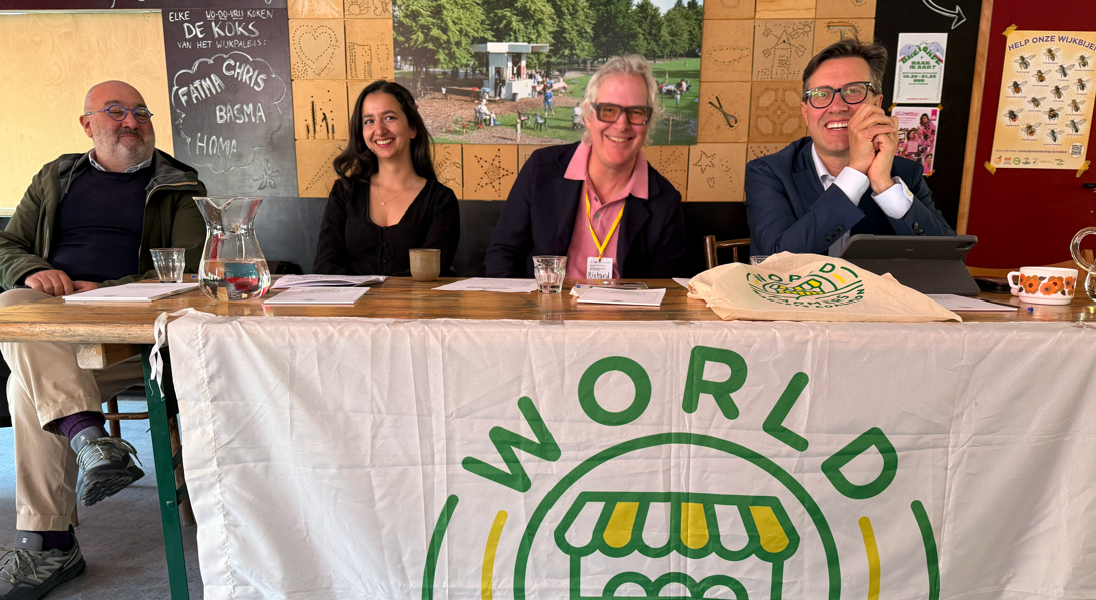
At the 2nd WorldFMC European Regional Meeting of the World Farmers Markets Coalition, Mina Morkoç delivered a compelling reflection on the role of local food systems in shaping healthier, more resilient, and more sustainable cities.
Speaking from the perspective of her work on climate and port policies in Rotterdam, Morkoç emphasised that food policy cannot be treated as a separate or marginal issue. Instead, she described it as deeply interconnected with climate resilience, public health, social cohesion, mobility, and urban development.
Food Policy Is Climate Policy
For Morkoç, local food systems must become a structural component of urban policymaking rather than an afterthought.
“Food policy is not just food policy,” she explained. “It is health policy, social policy, climate policy, mobility policy, it is an intersectional issue that we must approach as such.”
Working alongside colleagues responsible for health and social affairs, she highlighted the importance of integrating food systems into broader city strategies, especially in the context of climate adaptation and mitigation.
According to Morkoç, if cities are serious about climate resilience, public health, and stronger communities, then local food systems and farmers markets must play a central role.
Local Initiatives Struggling to Survive
Despite the growing importance of local food systems, Morkoç warned that many grassroots initiatives continue to face serious difficulties.
She referred to the recent closure of a local initiative in Rotterdam that had successfully connected local farmers and consumers but ultimately went bankrupt. According to her, the case revealed how local food networks often remain politically and economically invisible, despite their enormous social value.
“Local food initiatives are often seen as ‘nice to have’ rather than as essential infrastructure for the city,” she said.
For Morkoç, this invisibility is deeply problematic because access to healthy local food directly affects public health, biodiversity, social wellbeing, and community resilience.
Rethinking Food in Europe’s Largest Port City
As a representative of Europe’s largest port city, Morkoç also reflected on the responsibility that major urban and logistical centres have in shaping future food systems.
Port of Rotterdam is one of the largest and busiest ports in the world and plays a central role in global trade and food distribution. Yet Morkoç argued that discussions about ports and logistics often focus exclusively on large-scale global trade while neglecting regional resilience and local food systems.
“We are often the entrance and exit point of Europe,” she noted. “That also gives us responsibility when it comes to food policy.”
She called for a broader vision that balances international trade with stronger regional food networks capable of reducing dependency on fragile global supply chains.
Healthy Food Should Not Be the Exception
Concluding her intervention, Morkoç raised a fundamental question about the contradictions of contemporary urban food systems.
Why, she asked, is unhealthy ultra-processed food available everywhere in cities, while local producers and healthy food initiatives constantly struggle to survive?
For her, supporting local farmers and farmers markets is not only about economics or sustainability, it is also about protecting public health, strengthening social connections, and creating healthier urban environments.
“The local actors are the ones who keep us healthy and socially connected,” she stressed.
Her speech ultimately highlighted the need for cities to move beyond symbolic support for local food and instead recognise farmers markets and local producers as essential actors in the future of resilient, inclusive, and climate-conscious urban communities.