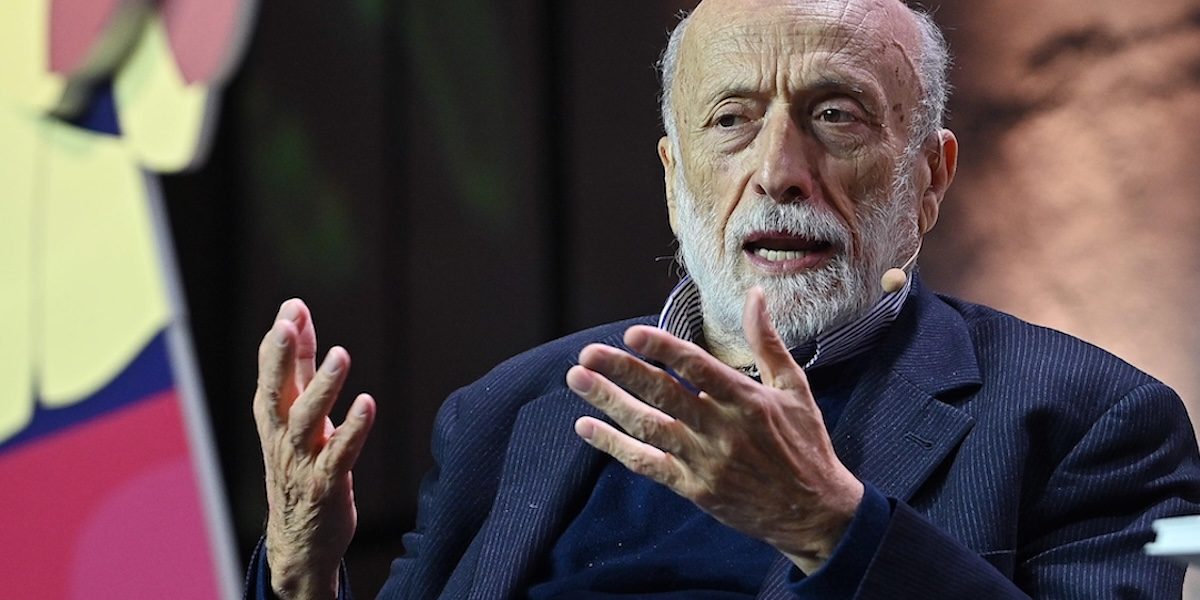
We share two tributes to a leader who inspired all of us, but in particular, World Farmers Market Coalition’s Viola Capriola and Richard McCarthy, each in different ways and via different points of contact. As farmers market founders, separated by decades, we both recognise the direct link between the Slow Food call for Good, Clean, Fair Food; and the most tangible way to do it — beneath the tents of pop-up farmers markets. A man with a way with words, at 76 years of age, Carlo Petrini leaves behind a treasure trove of slogans, insights, and statements that can fuel social change for the next 76 years. Among them is his quote, “Those who sow utopia, reap reality.”
Viola Capriola’s reflections:
Carlin represented, for many of us former students of the University of Gastronomic Sciences, a guide, a guru, an inspirational figure, or more simply a revolutionary brilliant mind, sensitive soul, and wise spirit to listen to, learn from, and occasionally engage in colourful and loud discussions – always in front of a good meal and a glass of wine, and always framed by humorous and rhetorical reflections.
In this moment of mourning, celebration, and tribute to a person who changed the way we think about, approach, study, and work with food, I personally find it difficult to find the right words to describe what Carlin represented to me. However, I feel certain about one thing: Carlin gave me one of the greatest opportunities of my life — the possibility to study what I love, food, through a holistic and systemic approach that opened my mind to a deeper understanding of the political, economic, social, cultural, and environmental implications of food.
I had the opportunity to study at UNISG thanks to a scholarship, and with that came both a profound sense of privilege for the opportunity I had been given and a strong sense of responsibility to give something back to the community in return. My work with Grønt Marked and the World Farmers Markets Coalition is deeply rooted in this.
More than anything, I believe Carlin taught us the importance of cultivating communities — the idea that only together, through respectful, inclusive and reciprocal relationships of exchange, those that value human beings and Mother Nature above anything else, we could truly contribute to a better and more just world.
Whether it was singing traditional Partigiani songs during cold nights in the Langhe wine cellars at the Easter Questure, or walking through the diverse colours, voices, dialects, and perfumes of the very first anarchic Terra Madre markets, Carlin made it clear to us all the importance of valuing, celebrating and acknowledging those who guard and shape our commons: our soil, landscapes, traditional and informal knowledge – as a form of resistance, justice and profound respect.
I pay tribute to a man who saw cultural and biological diversity as the true essence of resilience and beauty.
Richard McCarthy’s reflections:
By the time I learned of Carlo Petrini, I was three years into establishing farmers markets in New Orleans. I remember the day at the office, when we received a peculiar package of promotional literature (some in Italian, some in English) from Italy. The year was 1998. An organisation from Italy, known for its red snail emblem, was drumming up business for its new Salone del Gusto in Turin, Italy. I had never heard of Slow Food, but as soon as I saw the snail, the name of the organisation, and the playful tone evident in its literature, I knew that I was one of them. I joined as a member, almost immediately. By that moment, I had already championed sustainable agriculture, community agriculture, and worked for civic engagement in the farmers market revival. For me, our efforts were more than commercial pursuits. They were and remain political pursuits, designed to rekindle the badly-torn relationships between town and country, between supply and demand, and in my hometown, between black and white, old and young. As a result, the Slow Food call-to-action sounded like a clarion call for what we were already doing. There were many different ways to describe the meaning of our efforts; however, for me, it was Carlo Petrini’s Slow Food that summed it up best. More than the narrative itself, it has always provides a contagious, funny, and radical way to examine time, scale, transparency, and power.
Many years later, I came to fully appreciate Carlo’s genius to transmit a complex idea far beyond the Italian countryside that first inspired action. I had departed New Orleans to assume the role as the Executive Director for Slow Food’s USA arm. For six years, I tried again, and again, to interpret the Italian zest for joy with justice via food into the American context. As a New Orleanian, this seemed obvious. The combination of French, African, Sicilian, and other influences in my hometown all shared a belief that food is not (as is the norm in much of North America) just fuel. Instead, food is also an expression of place. It brings dignity to those who care about their food, irrespective of class, nationality, gender, etc. This was why when fellow Slow Food champion Poppy Tooker (with whom I often joined forces) and I spoke of New Orleans as “slow before its time,” we knew this to be true. However, (like farmers markets), Slow Food does not simply happen. It is an act of love, passion, and persistence. Otherwise, without it, fast food wins every time. Fast Food has the money, the power, and the allure of an easy life.
This is why Carlo Petrini’s gastronomic gospel meant so much to those of us who were already unfurling umbrellas in town centres, struggling to build trust with farmers and consumers who otherwise had little reason to trust any of us, and who were defending traditional meals, traditional breeds and plant varieties. With Slow Food, many of us had found a language to describe how our work fits into a broader cultural, political, and economic context. Or at least, that is what it meant to me.
In 2000, Carlo Petrini toured the United States to bring this gospel of good, clean and fair to the land of fast food. On his tour, he stopped in New Orleans. As a result, on one Saturday morning, Carlo Petrini arrived at the Crescent City Farmers Market to ring the opening bell. He marveled at the seafood, the varieties of produce, especially eggplants and tomatoes (of which many had first arrived by the hands of Italian migrants). With the advent of industrial food, some began to disappear: strawberries, artichokes, and fava beans. Within this context, farmers markets and Slow Food share common objectives: Identify vulnerable crops and dishes, propel them into commerce at the farmers markets, and kickstart the conversation as to why these foods matter, who can revive them, and who can earn dignified livings to product and process them into the 21st century.
For me, Carlo sent me on a journey that involved working closely with him to spread not only Slow Food, but the questions it raises about the scale, speed, and character of a dignified relationship with food. With a remarkable ability to dream up the craziest ideas, package them succinctly, and then inspire others to share in the dream, Carlo was a force. I am very sad to see him go, but feel some sense of comfort and hope that his ideas will only grow the more the world recognizes what he saw years before: That food provides profound joy; that it is an important source of identity; and that it is a bridge. Let’s continue to demonstrate just how strong is the bridge of farmers markets to achieve the aims that Carlo Petrini articulated in forming and leading Slow Food.