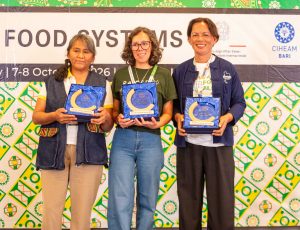
Behind every farmers market, there are people whose dedication, commitment and vision help build more sustainable, inclusive and resilient food systems. Farmers, market managers and local governments all play an essential role in strengthening connections between producers and consumers, supporting local economies and protecting our food heritage.
At the 4th World Farmers Markets Coalition General Assembly, held in Nairobi, Kenya, on 7 October 2026, the WorldFMC celebrated three outstanding contributions through the second edition of the WorldFMC Awards, recognising excellence in three categories: Best Farmer, Best Market Manager and Best City.
The 2026 winners were Jarinya Sonphungam from Thailand, recognised as Best Farmer; Ana Calderón from Mexico, awarded Best Market Manager; and Cochabamba, Bolivia, recognised as Best City.
Beyond the awards themselves, these recognitions celebrate the people and communities behind meaningful change. We invited the winners to share their experiences, reflect on what this recognition means to them and tell us how it inspires their continued work.
Here are their stories, in their own words.
Jarinya Sonphungam – Best Farmer, Thailand
For Jarinya Sonphungam, receiving the Best Farmer Award was much more than a personal achievement. It represented the journey from conventional farming, based entirely on chemical inputs, to organic agriculture and collective action alongside other farmers in her community.
Reflecting on the recognition, she shared:
“Receiving this Award was a deeply emotional moment for me. It means so much to see my hard work and journey recognised, from being a farmer who relied solely on chemical inputs to becoming an organic farmer and helping lead a group of like-minded farmers and friends. This recognition is not just for me, but for all of us who believe in organic farming and are working together to make a difference. When I returned to Thailand, I proudly shared this achievement with my friends and local government representatives, visiting them in person to show them the Award plaque. For me, this Award is a reminder of how far we have come together and an encouragement to continue promoting organic agriculture and inspiring others in our community.”
Jarinya’s journey is a reminder that change is possible and that farmers can be powerful drivers of more sustainable agricultural practices. Her story also highlights the importance of working together, sharing experiences and inspiring others to take part in the transition towards organic farming.
Ana Calderón – Best Market Manager, Mexico
As the manager of Mercado El 100, an independent initiative that has been working for 16 years to strengthen organic and local production, promote fair trade and connect rural and urban communities, Ana Calderón sees farmers markets as much more than places of exchange.
For her, they are spaces where relationships are built, knowledge is shared and social transformation takes place.
Looking back on her experience at the 4th WorldFMC General Assembly and receiving the Best Market Manager Award, Ana shared:
“Participating in the 4th General Assembly of the World Farmers Markets Coalition was a deeply enriching experience, both professionally and personally. I had the opportunity to share the journey we have undertaken with Mercado El 100 and, above all, to connect with people from different parts of the world who, from their own territories and realities, work towards a common purpose: building fairer, more sustainable and supportive food systems.
Receiving the Best Market Manager recognition brings me enormous joy and encourages me to continue my work at Mercado El 100, an independent movement that, for 16 years, has worked to strengthen organic and local production, promote fair trade and build bridges between rural and urban communities.
Throughout my journey, I have been involved in environmental education, community project management and collaboration among producers, organisations and institutions. Along the way, I have come to understand that markets are much more than spaces for commercial exchange: they are places of encounter, learning and social transformation, where we can strengthen local economies, create opportunities, encourage entrepreneurship and build fairer relationships with people and our environment.
This experience also reminded me of the value of the connections we build beyond our work: friendships, trust, solidarity and a sense of belonging that bring us closer and strengthen our social fabric. Meeting people who share our concerns and ideals helps us realise that we are not alone and that our work is part of something much bigger.
I take away from this General Assembly new ideas, lessons and partnerships, but above all, the strength and hope to keep moving forward, questioning what we do, improving our practices and strengthening our impact. Knowing that we are part of a global movement committed to the common good reinforces my belief that other ways of relating to one another, producing and organising our economies are possible, and that they are worth building together.”
Ana’s reflections capture the spirit of farmers markets as places that bring people together and create lasting connections. Her experience also highlights the importance of international exchange and collaboration in strengthening local initiatives and building a global movement for more equitable food systems.
Cochabamba, Bolivia – Best City
The Best City Award recognises Cochabamba, Bolivia, for its contribution to strengthening local food systems and supporting agroecological markets.
The reflections shared for the city come from Esther Mamani Soliz, the President of the ECO Feria Association in Cochabamba and representative of the Agroecological Movement of Latin America and the Caribbean (MAELA Bolivia), whose personal journey is deeply connected to her rural family roots, community work and commitment to agroecology.
She shared:
“My connection with agroecology comes from my rural family roots, where I learned to value the land, food and community work. I am a preschool teacher by profession and, in my daily life, I also contribute to environmental protection by producing and processing my own food for personal consumption, while working as an artisan and promoting recycling and reuse.
My journey within ECO Feria has allowed me to grow alongside other women and families who believe in agroecology, healthy food and a fairer, more supportive economy. As President of the Association, I have taken on the commitment to strengthen our organisation, support the work of our members and help create greater opportunities for agroecological producers.
I also serve as an evaluator within the Participatory Guarantee System (PGS), represent MAELA Bolivia and participate in the Farmers Markets Coalition on behalf of ECO Feria. These spaces allow me to exchange experiences and continue learning alongside other organisations and movements.
Receiving recognition from the World Farmers Markets Coalition has brought me great joy and motivation to continue along this path. To me, it represents recognition of the collective efforts of many people who, with commitment and perseverance, work towards healthy food, the protection of Mother Earth and the strengthening of our local markets.
Furthermore, this recognition has helped increase the visibility of our work and opened up new opportunities. We are currently beginning to work with the Municipal Council of Cochabamba to promote regulations that support agroecological producers and strengthen marketing spaces. It fills me with hope to see that many years of effort are beginning to create new opportunities to advance in the field of public policy as well.
As a woman, I feel deeply committed to agroecology. I believe it is essential to recognise the role of women in food production, the preservation of traditional knowledge and seeds, and community organisation. This recognition encourages me to continue contributing through my experience, convinced that collective action can bring about meaningful changes for our communities and future generations.”
Cochabamba’s recognition demonstrates how local initiatives, community organisations and the commitment of individuals can contribute to broader transformations. The emerging collaboration with the Municipal Council also shows how the work of farmers markets and agroecological movements can help shape local public policies and create a more supportive environment for producers.
Celebrating a shared commitment
Although their experiences and contexts are different, the three winners share a common vision: a food system that values people, protects the environment, strengthens local communities and creates opportunities for future generations.
Their stories remind us that meaningful change does not happen overnight. It is built through the everyday commitment of farmers, market organisers, communities and local institutions, often through years of hard work and collaboration.
Through the WorldFMC Awards, the Coalition aims not only to recognise these achievements but also to give visibility to the people behind them, encourage the exchange of experiences and inspire others across its global network.
Congratulations once again to Jarinya Sonphungam, Ana Calderón and the city of Cochabamba. Your work is an inspiration to the entire WorldFMC community!
Previous articles

Recent Posts

A New Chapter for WorldFMC: Nairobi General Assembly Elects t...