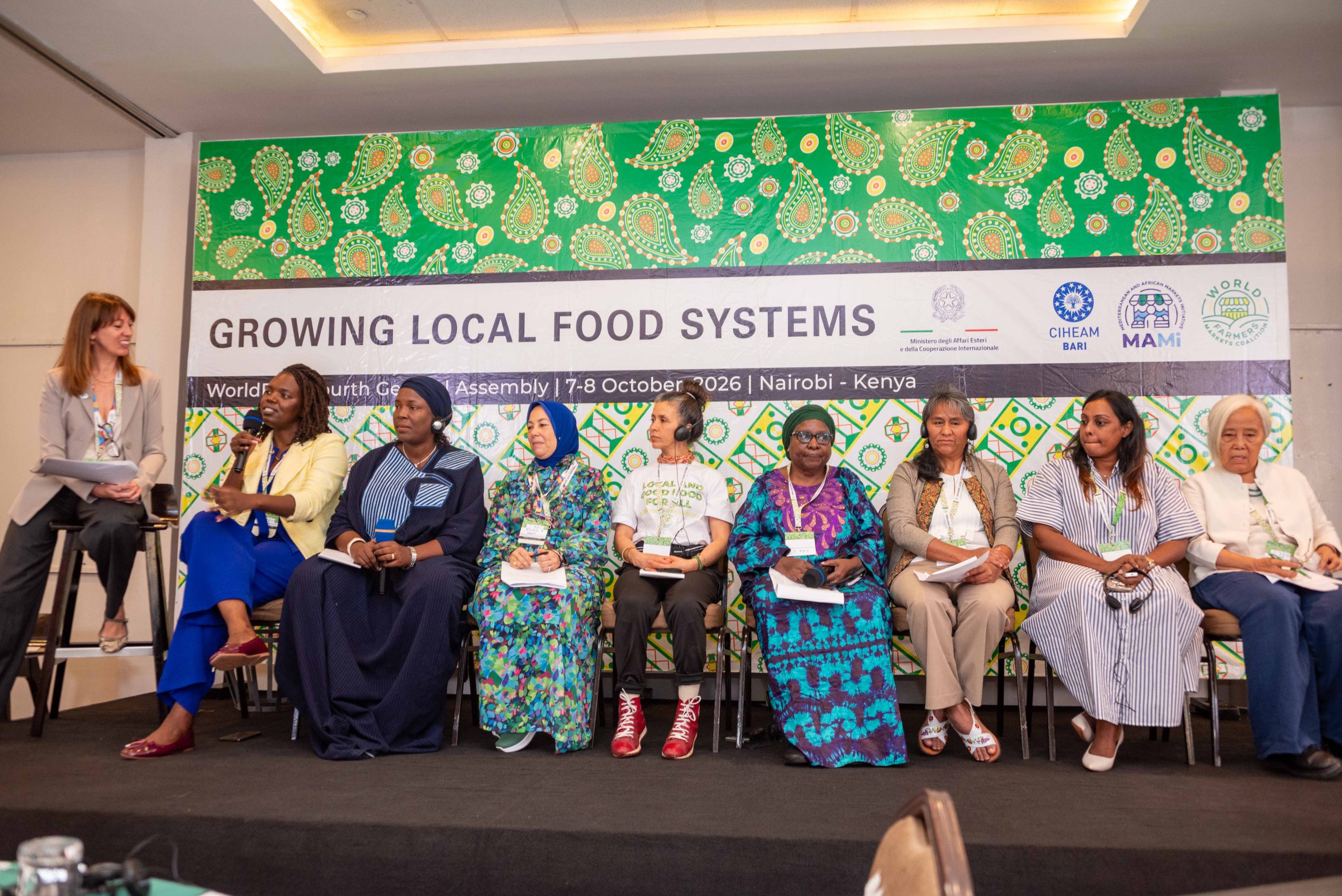
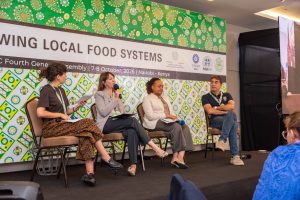
As part of the World Farmers Markets Coalition’s Fourth General Assembly in Nairobi, a panel organised in collaboration with the Food and Agriculture Organization of the United Nations (FAO) brought women’s voices to the centre of the conversation on the future of local food systems.
Held in the framework of the International Year of the Woman Farmer 2026, the session brought together women leaders and food-system practitioners from different regions to share experiences, challenges and lessons on how women are contributing to, and transforming, local agrifood systems.
The session was opened by Tacko Ndiaye, Gender Team Leader at FAO’s Rural Transformation and Gender Equality Division, and moderated by Valentina Sommacal, Senior Rural Institutions Specialist in the same division.
The conversation featured Catherine Banda, Kenyan Peasant League Women Articulation; Eman Seif, Alexandria Chamber of Commerce, Egypt; Paola Gomez, Mercado Agroecológico Tierra Viva, Colombia; Esther Mamani Soliz, Ecoferia Cochabamba, Bolivia; Wallapa Van Willenswaard, INI Innovation, Thailand; Achala Samaradivaka, Good Market, Sri Lanka; Lucy Mulenkei, co-founder and Vice President/Vice Chair of the International Indigenous Women’s Forum (FIMI); and Maimouna BAH Bayanga, co-Lead of the Agriculture Pillar, African Women Leaders Network (AWLN) Guinea National Chapter.
Together, they explored what it means to be a woman working for change in local food systems today, and how farmers markets and other local food spaces can contribute to greater empowerment, leadership and resilience.
From recognition to real change
Women play a fundamental role across agrifood systems, yet their contributions remain too often undervalued and insufficiently represented in decision-making. Unequal access to land, finance, technology, education, training and markets continues to limit opportunities for many women.
The panel moved beyond simply recognising these inequalities to focus on what women are already doing to transform their communities, and what is needed to strengthen and amplify their leadership.
Speakers shared experiences of mobilisation, entrepreneurship, collective action and community building, highlighting how women are creating change in their own contexts and developing new ways of strengthening local food systems.
Farmers markets as spaces for empowerment
A central part of the discussion was the role that farmers markets can play in creating more inclusive and resilient local food systems.
By connecting farmers directly with consumers, markets can provide opportunities to capture greater value, develop relationships, build networks and strengthen livelihoods. For women in particular, these spaces can also support greater economic independence, visibility and participation in local decision-making.
WorldFMC’s FMCOUNT! data already points to the significant presence of women in farmers markets. In the 2025 edition, which collected data from 34 farmers markets across 11 countries, 56% of interviewed farmers were women, while 91% of respondents reported owning their farms.
But the relationship works both ways.
Women are not only benefiting from farmers markets, they are also helping to shape them. As farmers, entrepreneurs, market managers and community leaders, women contribute to the social, economic and environmental value of these spaces and to the resilience of the local food systems around them.
Rethinking leadership
The conversation also raised a broader question: what does leadership look like when we place care, solidarity, collaboration and mutual support at the centre?
Women working across local food systems are often building change through relationships, mobilising communities, creating networks, supporting other producers and consumers, and bringing people together around shared challenges and opportunities.
Recognising these forms of leadership means going beyond traditional ideas of power and representation. It means creating institutional and political spaces where different experiences, knowledge and forms of leadership can shape decisions about the future of food systems.
From recognition to action
The discussion in Nairobi made clear that recognition is an important first step, but it cannot be the final one.
Supporting women’s leadership in local food systems requires concrete action: policies that remove structural barriers, greater access to finance and markets, inclusive organisational cultures, and decision-making spaces where women have an equal voice.
For farmers markets, this also means continuing to strengthen their role as platforms for women’s economic empowerment, participation and leadership.
The International Year of the Woman Farmer provides an important opportunity to recognise the women already driving change across food systems. But, as the discussion in Nairobi demonstrated, it is equally an opportunity to ask what comes next, and how the international community, local institutions and movements such as WorldFMC can help turn recognition into lasting change.
Women are already building the future
The stories and experiences shared during the session offered a powerful reminder that the transformation of local food systems is already happening.
It is happening in farms, markets, communities and organisations around the world, and women are at the heart of much of this work.
As the WorldFMC community continues to grow, strengthening these voices and creating more opportunities for women to connect, lead and exchange experiences will remain essential to building local food systems that are more inclusive, resilient and sustainable for all.
Previous articles
Recent Posts
From projects to impact: what national experiences are teachi...