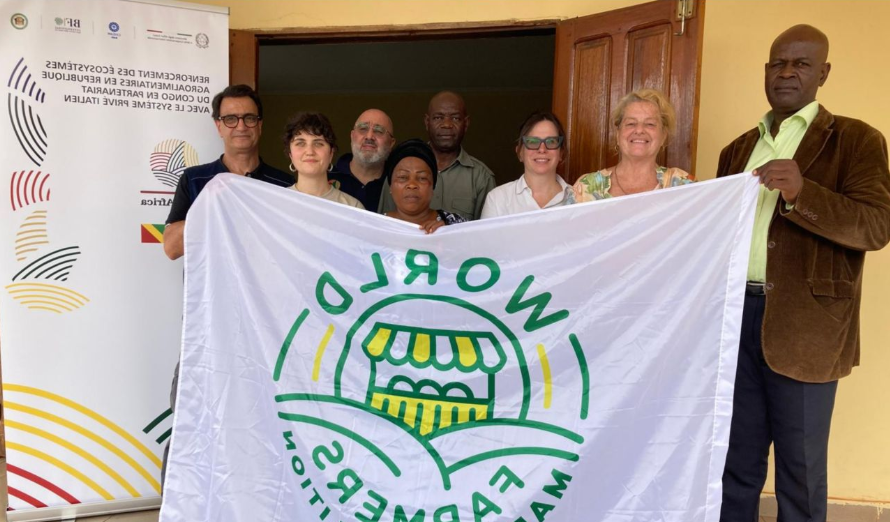
From 9 to 14 March 2026, the first mission under Action A.3.2 – Support for Multifunctional Agriculture and Pilot Actions (Republic of Congo) took place within the framework of the AREA Africa Congo Project.
The mission was carried out by Carmelo Troccoli, responsible for the activity, together with project coordinators Barbara Billocci and Viola Capriola in collaboration with CIHEAM Bari. The main objective was twofold: to identify a reliable local partner and to select the most suitable geographical area, between Brazzaville, Dolisie, and Pointe-Noire, where the pilot multifunctional agriculture initiative will be implemented.
To achieve these goals, the delegation visited all three cities, meeting local authorities, farmer organisations, cooperatives, and institutional stakeholders. The mission provided a clear and comprehensive picture of the agricultural system in the country and highlighted both the challenges and the strong potential for development.
A food system dominated by central markets and intermediaries
One of the most striking aspects that emerged during the mission was the strong presence of large central markets, which represent the main place where the population purchases food. These markets are lively and essential to local food supply, but they are mostly dominated by intermediaries rather than farmers themselves.
In fact, small farmers, who represent the majority of producers, rarely sell directly to consumers. Instead, they depend heavily on intermediaries who purchase products directly at the farm gate. Among them, the so-called “mialangoto” (women intermediaries) play a key role: they buy products from several farms, organise transportation, and supply the main urban markets, especially in Brazzaville and Pointe-Noire. While these women play an important logistical role, their dominance in the supply chain often leaves farmers with very little bargaining power and extremely low prices.
A strong need for farmers markets and short supply chains
Across all three cities, the mission clearly revealed a strong need to develop farmers markets and short supply chains. Small family farms, often organised in cooperatives of 7 to 20 members, produce vegetables, fruit, cassava, fish, and small livestock products, yet they struggle to access the market directly.
The absence of transportation systems and proper infrastructure makes it almost impossible for farmers to reach urban markets independently. As a result, most of the added value is captured by intermediaries rather than producers. Local farmer organisations and municipal authorities expressed strong interest in supporting initiatives that would allow producers to sell directly to consumers, increasing their income while strengthening the local food system.
Food waste and lack of infrastructure
Another critical issue identified during the mission is food loss and waste. Due to the absence of cold-chain infrastructure and processing facilities, a large share of agricultural production deteriorates before reaching consumers. According to information gathered during the meetings, approximately 30% of the products sold in current markets are thrown away every day.
This situation represents a major challenge but also a clear opportunity. Investments in cold storage, product processing, and logistics could significantly reduce waste while increasing farmers’ income and improving food availability in urban areas.
Institutional support and local partnerships
In Brazzaville, the delegation was welcomed at the Italian Embassy by H.E. Enrico Nunziata, Ambassador of Italy to the Republic of Congo, together with Dr. Alberto Gruden, Deputy Head of Mission. Their support was essential in helping the team better understand the characteristics of the country’s production and distribution system and the urgent need to modernise the agricultural sector.
The delegation also met Dr. Jacorcel Obabaka, focal point for the Republic of Congo of the Milan Urban Food Policy Pact and Attaché to the Prime Minister. During the meeting, Dr. Obabaka highlighted the strong commitment of the Municipality of Brazzaville to developing short supply chains and promoting local food consumption. This commitment is reflected in the city’s policy on urban agriculture, which has already led to the creation of around 80 agricultural plots along the Congo River.
The willingness of the local administration to collaborate was further confirmed by the Mayor of Brazzaville, Dieudonné Bantsimba, who expressed his availability to act as an institutional partner and to provide an area for the creation of a farmers market.
Dialogue with farmer organisations
The mission also included an important meeting with a delegation of the Concertation Nationale des Organisations Paysannes du Congo (CNOP-Congo), led by its President Séraphine Nédard Ntady. CNOP-Congo is one of the most important farmer organisations in the country, bringing together more than 2,000 members across several regions, including Brazzaville, Dolisie, and Pointe-Noire.
During the discussion, the representatives clearly expressed the urgent need to create farmers’ markets that would allow producers to sell directly to consumers. At present, most farmers are forced to sell their production to intermediaries at very low prices, losing a large share of the value of their work.
Dolisie and Pointe-Noire: challenges and opportunities
In Dolisie, the delegation, joined by Clelia Moroni, Project Manager of AREA Africa Republic of Congo at CIHEAM Bari, and Remo Zulli, Technical Coordinator of the AREA Africa Programme, met representatives of the municipality and local agricultural cooperatives.
As highlighted by Clelia Moroni “this mission confirmed the importance of building strong partnerships at local level. CIHEAM Bari is committed to working hand in hand with institutions and farmer organisations to develop inclusive solutions that enhance local food systems and create new opportunities for small-scale producers.”
During a meeting with Innocent Mabikana, Chief of Staff to the Mayor of Dolisie, it became clear that the local agricultural economy is mainly based on horticulture, cassava production, fruit, and fisheries. The municipality confirmed the presence of around 170 cooperatives, each composed of small family farms. However, the lack of transport infrastructure and cold-chain facilities makes it extremely difficult for producers to access markets, resulting in high levels of food waste and low income for farmers.
A further meeting with the directors of the Niari Department, including Rufin Blaise Massengo (Director of Fisheries and Aquaculture), Victor Mouelet (Director of Livestock), and Adolphine Mitsipa (Director of Agriculture), confirmed the urgent need for training, infrastructure, and better market access for farmers.
In Pointe-Noire, the delegation met several local stakeholders, including representatives of farmer organisations, chambers of commerce, and municipal authorities. Among them was a delegation of CNOP-Congo led by Nicole Moukila Horizon, President of the organisation in Pointe-Noire, who confirmed the strong interest of local cooperatives in participating in pilot initiatives aimed at developing short supply chains.
The delegation also met representatives of the Chamber of Commerce, Industry, Agriculture and Crafts, including Edgar Hardy and Achille Viaudo Bouiti, as well as Dr. Sylvestre Didier Mavouenzela, who expressed their willingness to collaborate and support the development of initiatives for local farmers, especially young people and women.
A meeting with the municipality of Pointe-Noire, represented by Dr. Rock Moutouari, adviser to the Mayor, further confirmed the strong role of central markets in the local food system and the need to strengthen direct sales opportunities for farmers.
Towards the pilot action
The mission represented an important first step in the implementation of Action A.3.2. Thanks to the meetings held with institutional representatives, farmer organisations, and local stakeholders, the delegation was able to identify key partners and better understand the needs of the agricultural sector in the Republic of Congo.
The strong interest shown by authorities and farmer organisations confirms that the development of multifunctional agriculture and farmers markets can play a crucial role in improving farmers’ livelihoods, reducing food waste, and promoting the consumption of local products.
Immediately following the mission, work with local partners is continuing to carry out an in-depth analysis of the local context, a crucial step to inform and guide the next phases of the project. This ongoing collaboration will ensure that the pilot actions are designed effectively to meet the real needs of farmers and communities, laying a solid foundation for sustainable local food systems
–
Le projet “AREA Africa République du Congo” s’inscrit dans le cadre de l’initiative italienne de coopération internationale, développé au sein d’un partenariat public-privé équilibré dans le cadre du Plan Mattei pour l’Afrique.
Il s’inscrit spécifiquement dans le cadre de l’Action pour le renforcement des écosystèmes agroalimentaires en Afrique (#AREA), cofinancé par le Ministère des Affaires étrangères et de la Coopération internationale (#MAECI), avec le CIHEAM Bari comme partenaire de connaissance et organisme de mise en œuvre pour la composante publique, et le BFI comme partenaire privé.