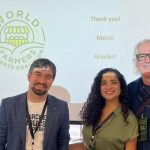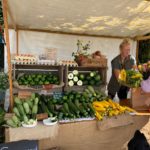
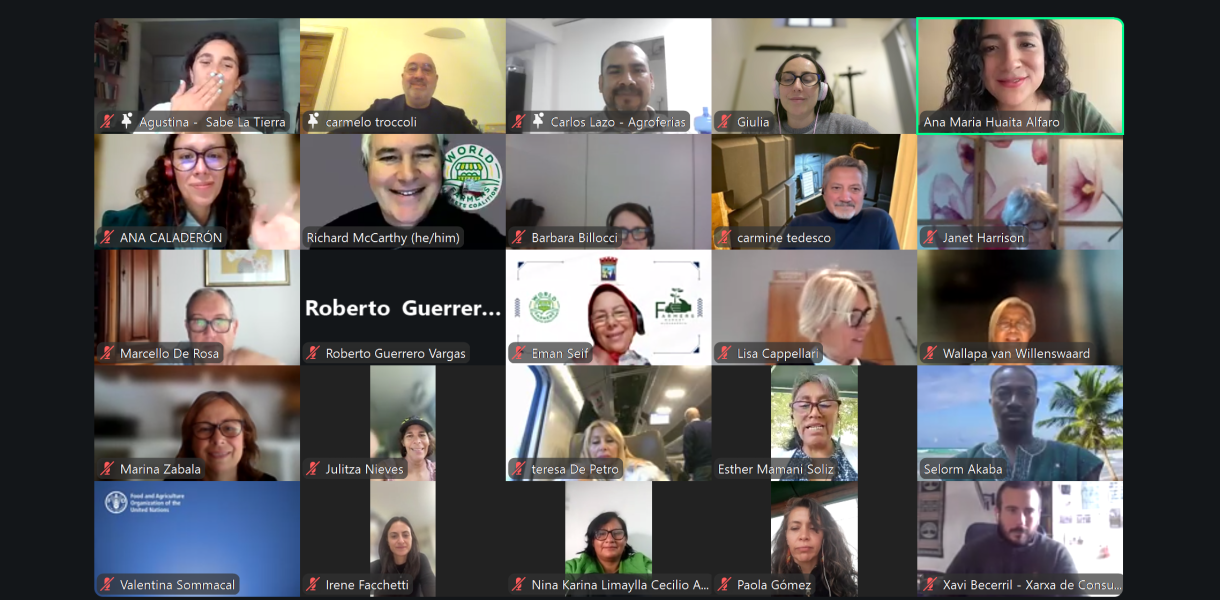
The last Academy Studio of the year focused on exploring how farmers markets in Latin America are developing and adapting strategies to reach new customers, while at the same time consolidating their work and expanding their impact within the local contexts where they operate. The session brought together experiences from Agroferias Campesinas (Lima), Sabe la Tierra (Buenos Aires) and Mercado El 100 (Mexico City), offering a rich exchange grounded in practice and territorial realities.
The discussion built on and expanded the findings of the Capacity Needs Survey conducted by the World Farmers Markets Coalition in collaboration with FAO, which gathered insights from more than 90 farmers market associations worldwide. While the survey had already identified word of mouth and social media as key tools for promoting farmers markets, this studio allowed for a deeper exploration of how these strategies take shape in different places, and what particularities, opportunities, and results emerge when they are adapted to local realities.
Throughout the session, participants examined the concrete components behind successful outreach and engagement strategies. Among the main aspects explored were:
- the approaches, tools, and target audiences used to attract new customers
- the information, knowledge, and resources that inform and support the development of these strategies
- the pending tasks, challenges, and capacity needs that farmers markets continue to face
Through presentations and exchanges among speakers and participants, several key insights emerged. Farmers markets consistently work to highlight the elements that differentiate them from other forms of food commercialization, particularly their ability to offer healthy, nutritious, and sustainable food alternatives. Beyond products, markets place strong emphasis on identity and values, positioning both farmers and customers as central actors in their operations. In this sense, producers and consumers are not only participants, but also ambassadors who help extend the reach of farmers markets within their communities.
Another important insight was the role of local authorities. The most successful strategies discussed showed that engaging municipalities and public institutions as allies can significantly strengthen visibility, legitimacy, and long-term impact. This reinforces the relevance of farmers markets within broader public policy agendas related to food systems, urban development, and local economies.
The session also highlighted how farmers markets often become spaces of “positive living”, particularly in contexts marked by social conflict, internal division, or heightened food insecurity. In these environments, markets function not only as places of exchange, but as social and cultural spaces that foster trust, encounter, and a shared sense of belonging.
Importantly, the strategies discussed extend well beyond digital communication. While social media plays a role, much of the impact comes from physical presence and everyday interactions. Communication becomes embedded in the routines and rituals of the market itself, in face-to-face exchanges, shared experiences, and the collective life that unfolds within these spaces.
By bringing together diverse Latin American experiences, this final studio of the year offered both practical lessons and broader reflections on how farmers markets can grow their audiences, strengthen their identities, and deepen their role in local food systems reaffirming their value not only as marketplaces, but as vital community spaces.
We introduced a new feature for this recording: since the original audio is in Spanish, you can switch to English by clicking the Settings button at the bottom of the video, selecting Audio Track, and choosing English (US) (please note that the label “English (Original)” actually refers to the Spanish audio).