Written by WorldFMC President, Richard McCarthy
As reported in recent communiques, we are launching new capacity-building projects in Ghana, Congo Brazzaville, and Senegal. These projects are part of the Italian government’s AREA Africa program. In April, we visited Congo Brazzaville and Ghana. The first mission to Senegal will take place in the coming weeks.
So far, these exploratory missions shed light on just how hungry farmers are for direct access to consumers, in order to redefine their business models. So, too, are municipalities keen to support the development of new farmers markets. In Congo, the (capital) municipality of Brazzaville and one of the nation’s largest farmers unions already maintain close ties. Both are looking for creative ways to improve consumer food environments whilst improving the livelihoods for farmers. These are some of the indicators we seek when determining how and with whom we will design the roadmap for new farmers markets.
In keeping with our theory of change that farmers markets are useful (and often among the first) steps to recalibrate agriculture around local needs, local opportunities, and entrepreneurism, we maintain these missions to learn how to match theories of change with the local context. Importantly, our capacity building work is to kickstart the steps farmers and communities take to diversify their agri-food systems. A term that by now may be familiar to many of you, our goal is to foment multifunctionality in agriculture. As a result, the development of farmers markets is to leverage opportunities that are within reach (with the help of management, structure, governance, and tents and umbrellas) in order to further develop local food systems, local food priorities and leadership.
When we arrived in Ghana, one of our first meetings was with the Minister of Agriculture, Hon. Eric Apoku. He described to us his painful learning experience as a young boy bringing his grandparents’ plantains to the market. Transport across the river was difficult, referencing the transport infrastructure challenges in Ghana that exist to this day. He also described how little leverage he had to set his prices. The middle men (in this case, Market Queens) set the price, and it was low for the plantains. Being young and confident, he refused the price on offer upon arriving at the market. Throughout the day, he sold none. At the end of the day, he was forced to flog his plantains to the same intermediaries, only to discover that the low price had sunk even lower throughout the day. As a result, he returned home with hardly enough cash to justify the day.
This very personal story led our meeting to cover territory that strikes at the heart of what we are doing in our AREA Africa engagement. What models can be built that strengthen the hand that the farmers have to set prices, forge healthy relations with “the market.” While we consider the development of farmers markets as not only an important first step, they represent a very public step. This allows consumers, farmers, and decision makers with opportunities to envisage another pathway. This pathway does not end with farmers markets. In fact, they are often only the first step. The market opens up new relationships with consumers, and new ways to trade on the authenticity of product, place, and experience.
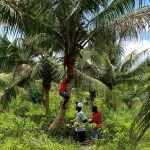
It is these experiences that link the farmers market to other points of sale. During our mission, we also met with and ate with farmers on their land. After all, our intent is to scan the existing ecosystem in order to understand what is happening already, and who envisages what can come next. It was one of these visits that reinforced just how ready farmers are to diversify their operations, and make the investments to slowly build a new model. This was especially evident when visiting two farms that are united by the Arise and Build initiatives to rethink agriculture. In one, we visited an organic pineapple farm that ships its fruit to the UK via fair trade channels. They also participate in the farmers markets developed by the University of Cape Coast. Via both channels, they focus on regenerative practices, quality, and differentiating their products from other farmers. We walked the fields, under a bright noonday sun. It was delightful to see how the farm had opted not to pursue monocrop practices (reliant upon scale and efficiency). Instead, the family farm cultivates a number of tree crops (coconut, bananas and plantains, and mangoes). On the ground, some of their crops are slow-moving (pineapples) and others fast growing (maze, okra, squash, and cassava).
The exciting point is this. Before we left the farm, to visit a neighboring farm for lunch, family members came running down the hill to our vehicles with pots and pans in their hands. They had been boiling the cassava spears, and cooking down a pepper and local berry concoction in which to dip the cassava. As the photographs and videos can attest, this may have been one of the more memorable meals we had in all of Ghana (a place that excels with a strong food culture). The meal was simple, the preparation literally out in the field and enjoyed with all of us standing around dipping cassava into the hot pot.
What became evident to us in this moment is that there is a great desire to be hospitable to guests on the farm, to share their agricultural practices with pride, and to provide simple yet meaningful experiences on the farm. So much of the discussion about agritourism is to examine the end product (often 15-20 years of slowly developing a farm stand, then a tasting room, then a café, and then eventually a bed and breakfast on the farm). This is the trajectory that is often cited, when we discuss the successful journey of agritourism.
After our cassava hot pot experience, we traveled to a nearby farm for lunch — an amazing lunch prepared by the cook who prepares meals for the farmworkers. Importantly, they refer to their cook as a chef, someone who prepares quality food because he works with quality ingredients: fish, coconuts, pumpkins, and amazing varieties of cow peas (designed specifically for the local – and ever changing – climate). Here, too, we experienced evidence of on-farm hospitality, and an opportunity to eat with the farmers and local agricultural leaders. More than just eating on a farm, we enjoyed the canopy provided by a coconut grove. As evidenced nearly everywhere we traveled, the built environment on the farm is constructed for efficiency and for experience.
What we got to experience is what these first steps look like. Agritourism need not be fancy, so much awareness of what consumers deem as special, authentic, and unavailable anywhere else (except on the farm). This is true for all on-farm sale experiences, whether it is running a Community Supported Agriculture (CSA) pick-up, a roadside stand (with an honesty box for DIY transactions), or an actual shop and/or restaurant. While our strategy is focused on the steps to develop farmers markets, it is important to remember that there is no single linear path. Farmers can support and participate in the development of farmers markets, while they can also begin to develop their own on-farm direct marketing. In this regard, Ghana represents a nation hungering for new models of direct marketing, but also already developing them in ways that can teach us all how to unleash the creative potential among farmers to add value to their farms in ways that extend beyond the field and beyond efficiency in production.