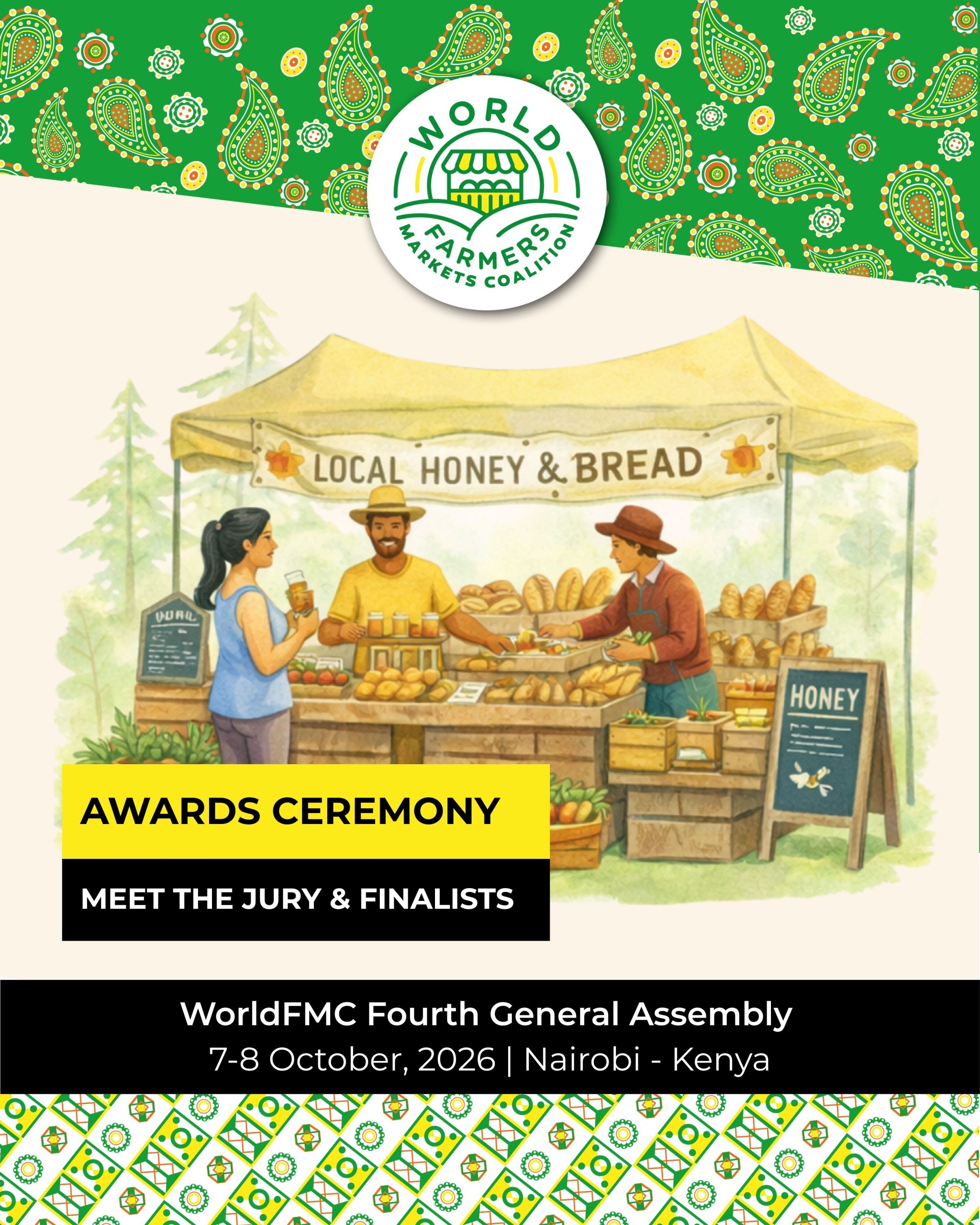
Following the great success of the first edition, the World Farmers Markets Coalition (WorldFMC) is once again celebrating the key players in local food systems with the second edition of the WorldFMC Awards, an initiative created to recognize and honor the people, markets and cities that contribute every day to building more local, sustainable, inclusive and resilient food systems.
Once again this year, the response from the international community has been extraordinary. More than 100 nominations were received from around the world, submitted both by WorldFMC members and by individuals and organizations outside the Coalition, reflecting the growing interest in the work of farmers markets and, more generally, in the role that local food systems can play in communities.
Nominations were collected in three categories: Best Farmer, dedicated to farmers who exemplify sustainability, innovation and commitment to their communities; Best Market Manager, aimed at those who lead and develop farmers markets capable of creating economic, social and cultural value; and Best City, which recognizes cities and regions that have succeeded in creating favorable conditions for the growth of local markets and food systems.
From over 100 initial nominations, the selection process led to the identification of three finalists for each category, nine stories from different continents that illustrate different approaches, contexts and ways of strengthening the relationship between farmers, markets, citizens and institutions.
The jury
The nominations are evaluated by a jury composed of industry experts, professionals and outreach workers engaged in promoting local food systems, with experience ranging from farmers market management to food policy, from international cooperation to urban development.
The jury includes Raoul Tiraboschi, food policy expert and Food Policy Advisor for the WorldFMC, who has been involved for many years in the development of local food policies and the strengthening of sustainable food systems; Thiago Gomide Nasser, co-founder of Junta Local in Rio de Janeiro, researcher and WorldFMC representative for Central and South America; Enrico Azzone, an expert in international cooperation with extensive experience in managing development programs in Italy and abroad; Kelly Verel, Co-Executive Director of Project for Public Spaces and head of the Market Cities Program, with extensive experience in the design and development of public markets; and Richard McCarthy, community development specialist, author and speaker, co-founder of the U.S. Farmers Market Coalition and President of the WorldFMC since 2021.
The composition of the jury reflects the international scope of the Awards and the variety of expertise needed to understand and appreciate the different ways in which local food systems develop around the world.
The finalists
Best Farmer
The Best Farmer category highlights three profoundly different experiences, united by their ability to combine agriculture, sustainability and community development.
From Kenya, Esther Mwangi Waithaka and Joseph Mwangi Waithaka of Jesilog Farms, nominated through Farmers Market Nairobi, represent a collaboration between generations. Mother and son have developed an agricultural model based on circular systems, solar energy, organic fertilizers and biological solutions for crop management. Their experience is also notable for their direct relationship with the farmers market and their commitment to sharing resources and knowledge with other small-scale farmers.
From Thailand, Jarinya Sonphungam, of the Nonthaburi Food Policy Council, describes a personal and agricultural transformation: from agriculture based on the use of chemical products to an organic model recognized as an example of best practice. Leading the Raj Niyom Organic Farm Group, she brings together 20 organic farmers and works to create new channels of market access, also collaborating with schools to promote more sustainable food supply systems.
From Argentina, Javier Rodríguez, nominated through Sabe la Tierra, is committed to supporting CAUQUEVA, a cooperative in Quebrada de Humahuaca that brings together small-scale indigenous farmers and works to conserve traditional Andean crops, such as potatoes, quinoa and corn. The project combines agroecology, biodiversity conservation, the promotion of ancestral knowledge and the creation of new economic opportunities for rural communities.
Best Market Manager
The three finalists in the Best Market Manager category describe the central role that careful and visionary management can play in consolidating a farmers’ market.
From Mexico, Ana Calderón, agronomist and director of Mercado El 100, brings over 15 years of experience leading one of the pioneering models of direct sales between producers and consumers in Mexico City. Her work has strengthened participatory certification tools, producer training and community-focused educational activities, forging ever-stronger connections between cities, agriculture and food culture.
From Poland, Alicja Kowalik, President of the Targ Pietruszkowy Foundation in Krakow, has helped transform the market into one of the key points of reference for the direct relationship between small producers and citizens in the south of the country. Particular attention is paid to organic producers, food education, waste reduction and the development of institutional partnerships capable of supporting the market’s long-term growth.
From Australia, Tim Walsh, a committee member of the Victorian Farmers Markets Association and a market manager with nearly 30 years of experience, has led numerous markets in the state of Victoria. His work combines a focus on the authenticity of producers with inclusion and community engagement. In 2026, he also played an important role in supporting farmers affected by the fires that devastated several areas of Victoria, helping to raise and distribute funds for producers.
Best City
The Best City category broadens the focus from individual markets to the entire urban and institutional context, recognizing cities that have created favorable conditions for the development of local food systems.
Cochabamba, Bolivia, nominated by Asociación ECO Feria, has followed a path marked by growing institutional recognition of agroecology. Among the most significant developments are the approval of a municipal law to promote agroecological production in Sacaba and the participatory process launched in Tiquipaya for legislation dedicated to agroecology and food sovereignty. At the same time, the strengthening of venues such as the ECO Feria helps to create new connections between producers and consumers.
Beirut, Lebanon, nominated by the Lebanon Farmers Market Coalition, is an example of the resilience of local food systems in a particularly challenging context. Despite crisis conditions and situations of extreme instability, the Badaro market has managed to maintain its operations and, over the same period, to double the number of vendors and customers, strengthening its role within the community.
Finally, Québec, Canada, nominated through the Association des Marchés publics du Québec, highlights the role of public institutions in the development of farmers markets. Since 2020, the city of Québec has invested approximately CAD 30 million in farmers markets and has worked with the sector to promote their presence in parks, streets and other public spaces. This approach has helped to create an ecosystem conducive to the growth of markets and the strengthening of the local food economy.
From Latin America to Asia, from Africa to Europe, and from North America to Oceania, the nine finalists showcase the diversity of experiences that characterize the farmers market movement and local food systems today.
Their stories speak of agroecology and biodiversity, access to food, innovation, tradition, resilience, inclusion, education, and collaboration between communities and institutions. But they also tell us something more: the ability of people and regions to create tangible alternatives through more direct relationships between those who produce food and those who consume it.
With the second edition of the WorldFMC Awards, the World Farmers Markets Coalition is therefore renewing its commitment to shining a light on these experiences and creating an international space for sharing and recognition for those who work every day to build stronger local food systems that are connected to their communities.
The WorldFMC Awards do not merely celebrate individual achievements: they highlight a global network of people, markets and cities that, through diverse experiences, help to keep the link between agriculture, territory, community and food alive.
Previous articles
Recent Posts
MAMi 2 Project: Mission to Alexandria Confirms the Success of...