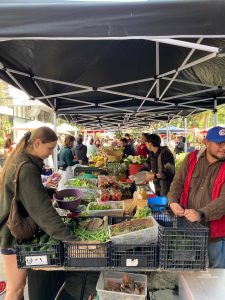
The latest AREA Africa mission in Ghana brought together local actors, farmers and the WorldFMC team to turn the findings of the project’s assessment into a practical roadmap for a new farmers market in Cape Coast.
How can stronger connections between farmers and consumers contribute to more resilient, sustainable and inclusive local food systems?
This was one of the questions at the heart of the latest AREA Africa Programme mission to Ghana, held from 28 August to 3 September 2026. The mission marked an important step in the transition from assessment and data collection towards the implementation of a pilot farmers market in Cape Coast.
The WorldFMC team, together with the Ghanaian focal point Dr. Selorm Akaba and local enumerators, reviewed the findings of the farmer survey, gathered additional insights from fieldwork, explored potential locations for the market and began developing the Strategic Plan and roadmap for the pilot.
Listening to farmers and local actors
A key part of the mission was a discussion with the local team of enumerators who had carried out the farmer data collection.
Their first-hand observations helped put the survey results into context and highlighted practical issues that will need to be considered when designing the new market. Discussions covered production volumes, product diversity, transportation, processing and storage, access to customers and markets, and the main constraints and opportunities affecting farmers’ participation.
The conversations also highlighted the diversity of local agricultural production. Important products such as garden eggs, turkey berry and cocoyam were identified as relevant additions to the product categories considered in the survey. There was also interest in value-added products, including washed and cut vegetables.
At the same time, farmers raised questions about demand and the risk of unsold produce, particularly for highly perishable products. These concerns underline the importance of developing a market model that can provide farmers with greater predictability while responding effectively to consumer demand.
Strong interest in direct market opportunities
The assessment points to significant interest in the farmers market concept. 84.78% of surveyed farmers expressed strong confidence in participating in a farmers market, while 95.7% indicated their readiness to engage with farmers markets to increase their income and secure better prices for their products.
The mission nevertheless identified several issues that will require attention as the pilot develops.
Seasonality is one of them. Many farmers currently depend on rain-fed production, with production declining during the dry season. The report suggests that more reliable market access could provide an incentive for farmers to diversify production and extend the period during which products are available.
Transportation is another consideration. While the survey recorded an average transport cost of approximately GHS 200 per trip, the Ghana team noted that this figure includes farmers located far from the potential market sites. Further analysis by district will therefore help identify the farmers most likely to participate regularly and better define the logistical requirements of the market.
The University of Cape Coast as a potential market hub
The mission also explored possible locations for the future farmers market, with the University of Cape Coast (UCC) emerging as a promising option.
The university already hosts an occasional farmers market and could offer existing infrastructure, facilities and networks that may support the development of a regular market.
For farmers, the campus could provide access to a larger and more stable consumer base. For consumers, the university’s involvement could contribute to confidence in food quality and safety. The site could also create opportunities for collaboration on research, student engagement, training and food systems innovation.
Connecting market access with sustainable agriculture
The pilot is being designed not only around better market opportunities, but also around the sustainability and resilience of local agricultural production.
The survey found that farmers are already using several Good Agricultural Practices, including crop rotation, intercropping and agroforestry. However, reliance on synthetic agrochemical inputs remains relatively high, while access to good-quality seeds and planting materials was also identified as an area requiring attention.
As a result, the emerging training programme will focus on sustainable soil management, integrated pest management, seed selection and propagation, as well as marketing, pricing and sales strategies adapted to farmers markets.
The project has set three-year objectives that include supporting at least 50% of participating farmers to reduce their use of synthetic agrochemicals by up to one-third, while at least 25% of participating farmers are expected to report increased on-farm biodiversity through the cultivation of at least one new crop or variety.
Training that responds to local realities
Another important outcome of the mission was a clearer understanding of how capacity-building activities should be delivered.
The Ghanaian team highlighted challenges associated with online and text-based training, including unreliable internet connectivity, limited access to digital devices, and language and literacy barriers. The report notes that approximately 80% of farmers are not literate.
The proposed approach therefore prioritises practical, participatory and locally adapted training delivered in local languages. A train-the-trainer model is also being considered to strengthen local capacity and ensure that farmers can continue to receive technical support at community level beyond the initial training activities.
From assessment to implementation
The final stage of the mission focused on developing the Strategic Plan and Logic Model that will guide the pilot.
The plan will translate the findings from the assessment into a practical roadmap for establishing a weekly farmers market in Cape Coast, defining key activities, responsibilities, timelines, capacity-building interventions and expected results. The Logic Model will remain a living document, allowing the team to review and adapt it throughout the remaining implementation period.
The Ghana mission therefore represents an important milestone for the AREA Africa Programme. The project is moving from data and assessment towards implementation, with farmers, consumers, local actors and project partners contributing to the design of a market model adapted to the realities and opportunities of Cape Coast.
The ambition is not simply to create another place to sell agricultural products. The pilot farmers market is being developed as a platform for stronger farmer–consumer connections, improved livelihoods, knowledge exchange, more sustainable production practices and the strengthening of local food systems.
Previous articles

Recent Posts
MAMi 2 Project: Mission to Alexandria Confirms the Success of...