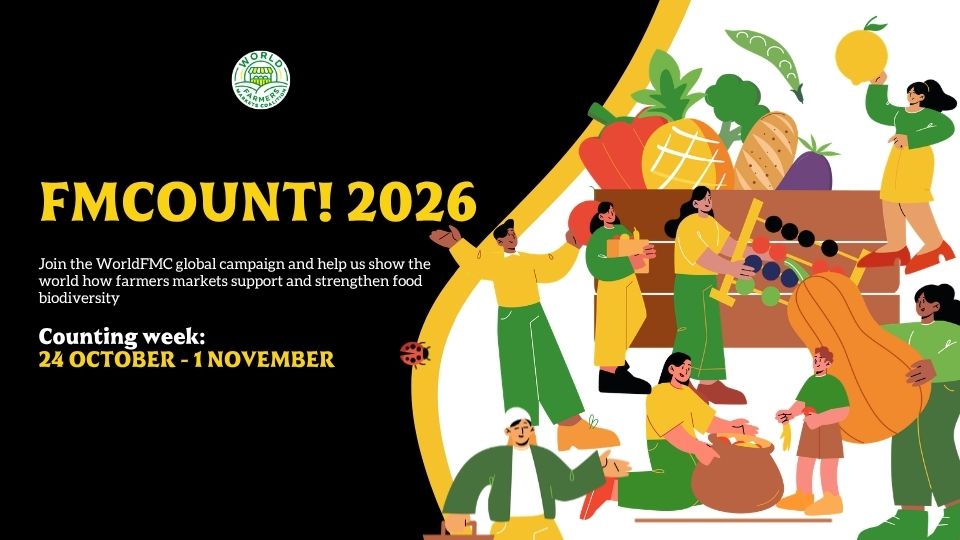
FMCOUNT! is a global campaign celebrating farmers markets as vital spaces for fresh food, community connections, and biodiversity. Through advocacy, data collection, and local actions, FMCOUNT! highlights the essential role farmers markets play in supporting biodiversity, rural livelihoods, and social inclusion.
In its second edition, markets around the world will document the diversity of plant-based products available on market day while engaging market managers and farmers in surveys to determine crop and varietal diversity among farmers and within regions. By combining quantitative data with interviews, FMCOUNT! Will bring numbers to mounting evidence that farmers markets contribute to maintaining, promoting and reproducing agricultural biodiversity. Findings will contribute to future policy and practice.
Sign up now!
Farmers markets count when it comes to biodiversity
FMCOUNT! is a global campaign launched by the World Farmers Markets Coalition (WorldFMC), designed to make visible and better understand the contribution that farmers markets can make to fresh food, biodiversity, farmers’ livelihoods, community connections and social inclusion.
For its second edition, taking place from 24 October to 1 November 2026, FMCOUNT! turns its attention to agricultural and plant-based biodiversity, bringing together farmers markets, market managers, farmers and researchers to document the diversity found in markets and explore the ways in which markets may contribute to conserving, maintaining and reproducing it.
The campaign combines a practical biodiversity count with surveys of market managers and farmers, creating a picture that connects what is available at the market, what farmers grow, and how the market environment may influence diversity.
The ambition is simple: to put numbers and experiences behind the idea that farmers markets count when it comes to biodiversity.
Why Biodiversity
Biodiversity is not only about the number of species that exist in nature. Agricultural biodiversity also depends on the diversity of crops and varieties that farmers cultivate, exchange and bring to consumers.
Since farmers markets facilitate direct connections between farmers and consumers, they provide a place where local, traditional, heirloom, neglected and underutilised varieties remain visible, available and commercially relevant.
The 2026 edition of FMCOUNT! seeks to better understand this relationship.
The campaign investigates the diversity of fresh plant-based products available at farmers markets, while also exploring farmer motivation for cultivating a broader range of products and varieties, and the extent to which participation in a farmers market influences decisions on the farm.
Sign up now!
The FMCOUNT! Biodiversity Count
At the heart of the campaign is a simple idea: Count what is there. Ask how it got there. Understand why it matters.
Participating markets will carry out a biodiversity count on a single market day.
Market managers or trained volunteers will move from stall to stall, counting the different plant-based products and varieties available for sale and recording them using the campaign’s polling sheet.
The count covers: Fruits, starchy staples, vegetables, including mushrooms, herbs and legumes, nuts and seeds.
The scope includes fresh and dried plant-based products and wild-harvested products, while excluding grains and cereals, processed products such as jams, sauces and chutneys, and animal protein.
From counting products to understanding farmers
FMCOUNT! will combine the biodiversity count with two complementary surveys:
Market managers: Market managers will provide information about their market, including its location, size, history and number of participating farmers. They will also be asked about the extent to which biodiversity is reflected in their market’s mission, policies and activities.
Farmers: Farmers participating in the markets will be interviewed about their motivations for cultivating multiple varieties, including neglected and underutilised species, and the potential influence of farmers markets on these practices.
This is important because biodiversity at the market is only one part of the story. The campaign also wants to understand decisions behind that diversity.
The research behind FMCOUNT! 2026
As part of the second edition of the FMCOUNT! campaign, the WorldFMC global network is collecting insights into the role of farmers markets in supporting biodiversity. Using a mixed-methods approach, the initiative will combine quantitative data collection with interviews to capture both measurable data and lived experiences. Data will be collected primarily at farmers markets, engaging both farmers and market managers. The findings will inform the development of a technical brief by WorldFMC and FAO, contributing to a deeper understanding of the opportunities and benefits of advancing biodiversity through farmers markets, as well as the motivations behind farmers’ choices. The initiative will provide evidence to support future policy development and practice.
This research component gives the second edition of FMCOUNT! a broader purpose: building evidence that can help inform future policy and practice.
The data collection will bring together three complementary sources of information:
Biodiversity count: What plant-based diversity is physically present at the market?
Market manager survey: How do farmers markets understand, promote and support biodiversity?
Farmer survey: What diversity do farmers cultivate, why do they cultivate it, and does participation in farmers markets influence these practices?
Together, these elements are intended to provide a more comprehensive picture of the potential role of farmers markets in maintaining and promoting agricultural biodiversity.
A global effort
More than 100 farmers market associations from the WorldFMC network, covering 80 countries and approximately 28,000 markets, will be invited to participate. Associations are also encouraged to extend the invitation to markets beyond the existing WorldFMC network.
The approach is designed to support geographic and market diversity while keeping the data collection practical and manageable for participating organisations.
Participation is voluntary. Participating market managers will receive training and practical guidance, while the biodiversity count will be conducted by market managers or trained volunteers using tools provided by WorldFMC.
Data collection is planned for October–November 2026.
What will happen to the data?
The data will undergo cleaning and validation by the WorldFMC. The validated dataset will then be shared with the FAO team, who will provide an initial statistical and qualitative analysis. The species identified through the biodiversity count will also be compared with the Global Vegetables Species dataset.
The ultimate objective is not simply to produce a list of crops. The information gathered will help explore a bigger question: Can farmers markets be platforms for maintaining, promoting and reproducing agricultural biodiversity?
The campaign seeks to provide evidence around the opportunities and benefits and to understand how connections between farmers, markets and consumers can create opportunities for greater diversity in what is grown, sold, consumed and reproduced.
Sign up now!
Previous articles
Recent Posts
A Growing Global Coalition, United by a Shared Vision