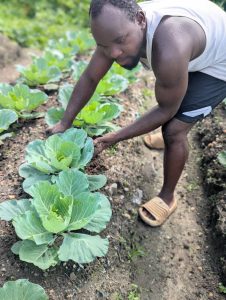
Green shoots and the rise of the Republic of Farmers Markets
In October 2026, we held the World Farmers Markets Coalition’s Fourth General Assembly in Nairobi, Kenya. With three years of rapid growth and development under our belts since the founding Assembly in 2023 in Rome, I am proud to have served with such a remarkable global board of directors. Thank you, Thiago Gomide Nasser, Randi Ledaal Gjertsen, Jean Charles Khairallah, Ha Tran Thi Kieu Thanh, Selorm Akaba and Naima Akter.
During these three years, we have identified many of our planet’s most driven, inventive, and grounded local food leaders. When Director General Carmelo Troccoli first reached out into the digital ether in 2020 and 2021 to determine if there were others like him out there — developing new models for urban-rural linkages via food, he did not know if there were others like him. He did not know if now was the time to build a community of practice. For those of you who were there during those formative meetings, it may seem like we have always been a global community. I marvel when I look at my phone (daily) to witness and participate in conversations between practitioners from and between parts of the world that have grown ever closer together due to the WorldFMC.
What struck me during this General Assembly is how familiar our shared language has become (even if via simultaneous translation), how warm and natural are the friendships that are growing from tent to tent. Yes, we conducted the important legal requirements of an electoral General Assembly. I am both honoured and humbled to accept the support of our membership to serve another three years, together with a Board of Directors who includes both returning and new members: Jean Nick Trudel, Thiago Gomide Nasser, Randi Ledaal Gjertsen, Dennis Andaye, Jean Charles Khairallah, Achala Samaradivakara and Wallapa Van Willenswaard, together with our returning Auditor, Stefania Marongiu. I am also very happy to see the outcomes of the often awkward and clumsy process to write and approve two important position papers with active co-writing from our membership. The success of these two documents (one on local food policy and the other on food waste) is due in part to the patient listening by the International Secretariat’s Barbara Billocci and Raoul Tiraboschi.
Despite the challenges of travel – and these days that is no small issue, I also noticed the level of commitment members are making to ensure that the conversations that take place internationally are shared with their team at home. For those who have attended exhilarating meetings away from home but struggle to translate what lessons learned apply at home, you can understand the joy to see members, like Grønt Marked and BREADA, devote their own resources to bring more than just one representative. This speaks to a full bodied commitment to learn and to shape the future of farmers markets not as stand-alone niche experiments, but as fulcra for systems change.
This gets to the heart of the matter. In addition to the important memoranda of understanding we signed with key international organisations, like UN Habitat and CGIAR, and to the important interfaces with national representatives, most notably the Minister of Agriculture of Kenya (put name here?) and Italian representatives (put names here?), what really excites me is this. Our global community spent hours in guided discussions to define where we fit into the ecosystem of local food, and how we can best harness our strengths to make systemic changes to farmers’ everyday lives, consumers’ everyday lives, and to the shared imaginations of the social contract that binds us together.
It is within this context that I accepted the mandate of our members to serve for three more years as President. It is here that I presented to imagery of how I see farmers markets emerging as surprising and refreshing emblems of hope in a time that desperately needs working models that can scale out and repopulate our landscape with interactive academies to relearn how to sustain communities, how to feed families, and to revalue each other. For this, I see us emerging like green shoots in the cracks of the pavement in our crumbling world. It is easy to fall prey to despair. However, once you engage with farmers markets, you quickly shed hopelessness and replace it with pragmatic utopianism. Of course, we know that our farmers markets are small (when compared to the girth of industrialised food). Of course, we know that the weaknesses you can find in all of our markets reflect the weakness (and in some cases, thankfully, the strengths) in our local food systems. However, regardless of the scale or biodiversity of your farmers market, it not only reflects what is but also a pathway to what can be. Why? It is interactive. Aside from the transparency you insist on with clearly marked rules, governance, regulations, and the presence of management, this is building the road as we travel. Together. Farmers, consumers, allies in government, civil society, business, etc. This is our secret strength. Not only do we emerge from these cracks in the system, but we grow whilst we learn. It is this rare ability to grow that new way of farming and selling out in the open that inspires others to mimic what we do. It inspires others to develop similarly democratic and practical efforts that affect everyday lives. From farmers markets, new businesses emerge based on the same principles. From markets, processing laboratories fill in other infrastructure gaps (from farm to fork, from lake to plate).
In this regard, this is where I feel that we are growing our legs to demonstrate that in our individual and collective Republic of Farmers Markets, we can regrow the social contract in our own places and between places that will restore stability, vibrancy, community, and love around a shared connection to food.
Thank you to all of you who took time from your crazy schedules to contribute to this global vision for cultivating community and for the regenerative possibility of local food.
Previous articles

Recent Posts
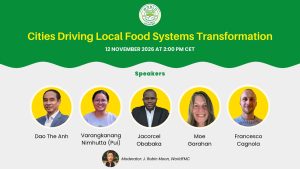
Cities Driving Local Food Systems Transformation: Join the Ne...